Transit-supportive densities
This blog graphs the amount of density necessary to support transit. In my experience, city and transit (public transport) planners have difficulty effectively explaining this relationship. To wit, if you want “frequent” transit service, you need 20 du/ac. Is this duplexes, high-rises, or townhouses?
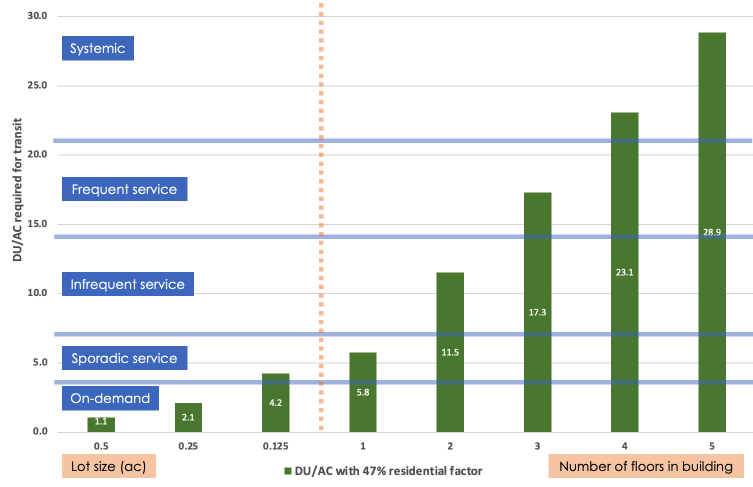
The chart below visualizes transit-supportive density. It compares the number of dwelling units per acre (du/ac) in typical development patterns to the du/ac required to support various levels of transit service. The du/ac are shown with a high and low street ROW factor (details below). The left three bars represents single-family detached housing on 1/8 to 1/2 acre lots. The right five bars represent row houses and apartments, from 1 to 5 stories.
Take aways
1/4-acre lots and larger only support on-demand transit service and/or taxis.
1/8-acre lots and 1-story apartments support sporadic transit service.
3-story row houses are required to support frequent transit.
4 and 5-stories apartments are required for systemic transit (transit is the prevailing mode).
Of course, an area’s density is only one aspect. It is necessary for the dwelling units to be located near the transit stops, and for there to be a good way to walk or cycle back and forth. However, many guides already focus on these aspects.
Below I explain the methodology.
Transit service levels
The first step was to understand the number of dwelling units per acre (du/ac) necessary for various levels of transit service. Culled from the two sources below, my best assessment is:
Systemic: >30 du/ac
Frequent: 20-30 du/ac
Infrequent: 10-20 du/ac
Sporadic: 5-10 du/ac
On-demand: <5 du/ac
Residential v. non-residential area
The above transit service levels speak of residential density, expressed in dwelling units per acre. I believe this may be an inflated metric because it does not account for other land uses. For example, a subdivision of quarter-acre lots suggests there are 4 DU/AC. However, there are also streets, parks, shops, schools, and other uses in the subdivision. Hence, we need to apply a residential factor to the metric.
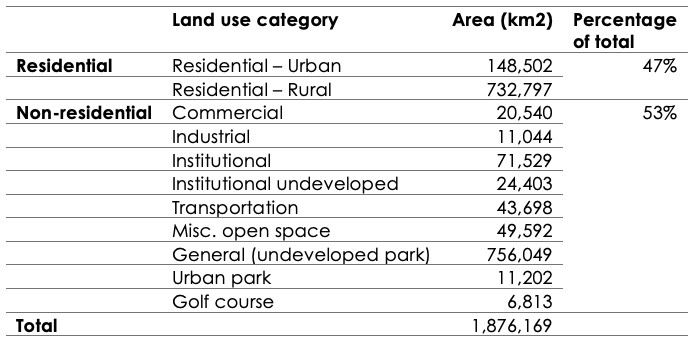
Various data sets list land use percentages in the United States, from housing to parks to farming, see citation below. Interpreting the data, I calculated that 47 percent of built-up area is residential.
Factored dwelling units per acre
Applying the 47% factor, I calculated the factored DU/AC for representative residential areas. Taking the quarter-acre lot example, the DU/AC is 2.1, not four.
Assuming one dwelling unit per lot, the number of dwelling units for (suburban) developments is:
1/2-ac lots: 1.1 du/ac
1/4-ac lots: 2.1 du/ac
1/8-ac lots: 4.2 du/ac
For (urban) developments, I used the number of floors and a 50% lot coverage percentage. This allows for a building and yard(s) of equal size. I used a 2000 SF apartment unit.
1-story buildings: 5.8 du/ac
2-story buildings: 11.5 du/ac
3-story buildings: 17.3 du/ac
4-story buildings: 23.1 du/ac
5-story buildings: 28.9 du/ac
Resources
Land Use Density and Clustering, TDM Encyclopedia, Victoria Transport Policy Institute, Updated 6 September 2019, https://www.vtpi.org/tdm/tdm81.htm.
“As a general rule of thumb, 4-7 dwelling units per acre are required to create demand for ‘basic’ bus transit service (20-40 buses per day), 6-15 units per acre are required to create demand for “frequent” bus transit service, 9 units per acre are needed to create demand for light rail transit, and 12 units per acre are needed to create demand for rapid transit (Transit Evaluation).”
CRCOG Best Practices Manual, Chapter 5 Fact Sheet, Transit Oriented Development, https://crcog.org/wp-content/uploads/2016/07/Ch05_FactSheet_TOD.pdf.
“Generally, the greater the intensity of residential and office development, the greater the levels of transit ridership. The absolute minimum residential density required to support any form of regular, on-street bus service is about 6 to 8 units per acre, on average, for a transit corridor. For express bus service with exclusively pedestrian access (i.e., no park-and-ride facilities) minimum average densities for the corridor should be about 15 units per acre. However, ridership levels at such minimum densities tend to be relatively low and heavily concentrated during commute hours. As densities are increased, ridership increases. Notably, researchers have found that there are sharp increases (a tripling) in ridership as average residential densities approach 30 units per acre. In the downtown area, a minimum density of about 50 employees per acre is necessary to support regular transit service, and people do not switch from driving to transit until employment densities reach about 50 to 75 employees per acre.”
Theobald DM (2014) Development and Applications of a Comprehensive Land Use Classification and Map for the US. PLoS ONE 9(4): e94628. https://DOI.org/10.1371/journal.pone.0094628.
Adapted from Table 3.